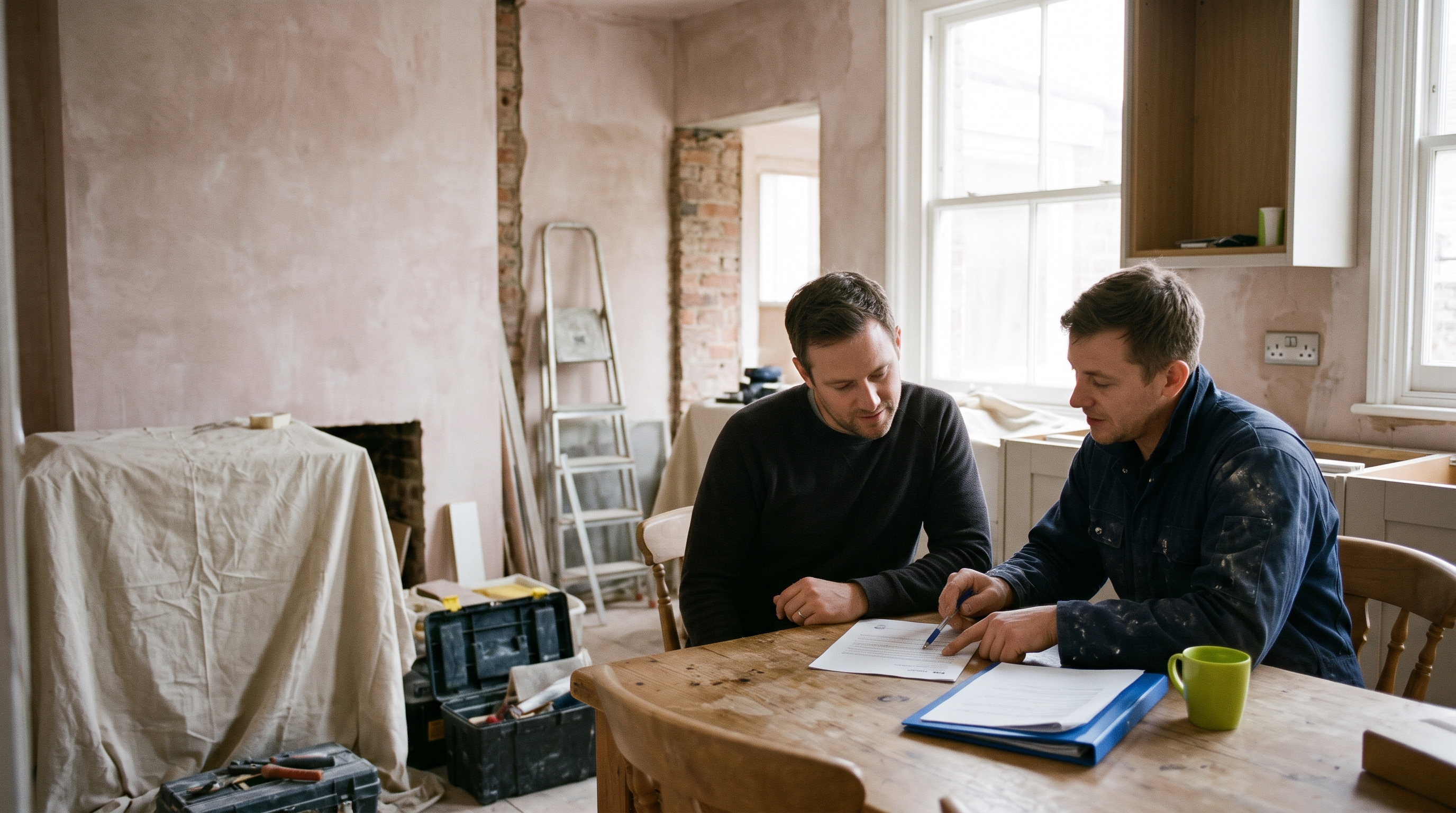
Pay as little upfront as you reasonably can, and no more than 25% of the job price. That's the ceiling Citizens Advice suggests. On many jobs the right deposit is smaller, and on some it's nothing at all.
The rest should follow the work: paid in stages as each part is finished, with the final payment held until you're happy.
A builder asking for a deposit isn't a red flag on its own. It's normal on bigger jobs. What matters is how much, what it's for, and what you get in writing before you hand it over. Here's how to get that right.
Key Takeaways
Citizens Advice suggests you don't agree to a deposit of more than 25% of the job price, and to push it lower where you can.
A deposit should cover something real, usually materials or made-to-measure items ordered for your job. Ask to see the supplier's invoice.
Get a written quote, a written contract with a payment schedule, and a receipt before any money changes hands.
Pay by card if you can. Citizens Advice advises against paying in cash.
After the deposit, pay in stages as work is done, and keep the final payment until you're happy with the job.
Is it normal for a builder to ask for a deposit?
Yes, on the right jobs. A deposit followed by payments at agreed stages is a common way to pay for building work, and Which? Trusted Traders says it's entirely reasonable to ask for staged payments on a big project where the builder has a lot of materials to buy.
There's usually a sensible reason. A new kitchen, a set of bespoke windows or a steel beam doesn't come cheap, and someone has to order it before work starts.
Which? Trusted Traders puts it neatly: a deposit should only really be needed when the trader has to buy goods for your job, or is working on a bespoke design.
So the question to ask isn't "Do you want a deposit?" It's "What will the deposit pay for?"
When a deposit request should worry you
Be wary if a builder asks for money for materials before you've even agreed to give them the job. nidirect, the official Northern Ireland government site, flags this as a reason to be suspicious.
The same goes for anyone who wants the whole job paid upfront, or will only take cash. Citizens Advice says both can be a sign a trader isn't honest or reliable.
How much deposit is fair?
Treat 25% of the total price as the upper limit, not the starting point. Citizens Advice suggests pushing the deposit down as far as you can and not agreeing to anything above 25%.
A fair deposit is one that matches what the builder genuinely needs to spend before work starts. That depends on the job:
Small repair or odd job: often very little, as there are few materials to buy. Ask for: paying on completion, or only for any parts ordered.
Kitchen or bathroom refit: units, worktops, tiles and sanitaryware ordered for you. Ask for: the supplier's quote or invoice for those items.
Extension or loft conversion: first materials, skip or scaffold hire, made-to-measure items. Ask for: a written breakdown, then stage payments for the rest.
If a builder asks for a large deposit, Which? Trusted Traders suggests asking whether your upfront payment is protected by insurance. Citizens Advice gives the same advice: some traders have insurance that returns your deposit if they go out of business.
Can you buy the materials yourself instead?
Often, yes, and it's one of the simplest ways to cut the deposit. Citizens Advice suggests offering to buy materials yourself when a builder asks for a deposit to cover them. That way, if something goes wrong, the materials are yours.
If you'd rather the builder orders them, nidirect recommends asking to see the supplier's invoice, paying that amount, and keeping a receipt.
One catch: if you're supplying materials, make sure they turn up on time. A builder standing around waiting for your tiles is nobody's idea of a good day.
What to agree before you pay a penny
Before any money changes hands, get these four things sorted.
1. A written quote, not an estimate. Citizens Advice explains that a quote is a fixed price, while an estimate is a rough guess. Ask for it in writing, with the work and materials broken down and VAT made clear. Try to get quotes from at least three builders.
2. A written contract. It doesn't need legal language. It just needs to set out what you're paying for, the start and finish dates, who pays for materials and skips, and how and when you'll pay. Citizens Advice says to be wary of any trader who won't put anything in writing.
3. A payment schedule. Agree exactly what the deposit covers and which points in the work trigger each later payment. "When the walls are up" is clearer than "halfway through".
4. A receipt for the deposit. Always. Plus receipts for any materials the deposit pays for.
If you sign the contract in your own home, you'll usually have a 14-day cooling-off period, as Which? Trusted Traders notes. For anything you're unsure about legally, Citizens Advice is a good first stop, and a solicitor can check a contract for bigger jobs.
Not sure your builder is who they say they are? Our guide to finding a verified professional covers the checks worth doing before you get this far.
How to pay the rest: stage payments
After the deposit, pay as the work progresses rather than in one big lump. Citizens Advice calls paying in stages a good idea, because problems can be put right before you make the final payment.
Stage payments work best when each one is tied to something you can see. For an extension, the stages might look like this:
Deposit for first materials
Foundations dug and signed off
Walls up and the roof on
First fix done (wiring and pipes in, before plastering)
Completion, once any snags are fixed
The exact stages depend on your job, so agree them with your builder and write them into the contract.
Keep the last payment until you're genuinely happy. Which? Trusted Traders recommends making the final instalment payable only once you're satisfied with the work.
This protects your builder too. A clear schedule means they know exactly when they'll be paid, with no awkward chasing.
How should you pay the deposit?
By card if you can. Citizens Advice recommends paying by debit or credit card, using a bank transfer if card isn't possible, and not paying in cash.
Paying by credit card can bring extra protection under Section 75 of the Consumer Credit Act. In England, Scotland and Wales it can apply to things costing over £100 and up to £30,000, services included, and MoneyHelper explains that paying just the deposit by credit card can be enough. Paying through a middleman, such as a logged-in PayPal account, can remove that protection, so check with your card provider first.
With bank transfers, confirm the account details with your builder directly, by phone or in person. Which? Trusted Traders warns about scammers sending fake invoices by email.
Red flags when a builder asks for a deposit
Most builders are honest and just want to cover their costs. These signs suggest you should slow down:
They want all or most of the money upfront. Citizens Advice advises never agreeing to pay everything before work starts.
Cash only. You lose the protection that comes with card payments, and Citizens Advice links cash-only traders with dishonesty.
Nothing in writing. No written quote, no contract, no receipt.
A deposit before you've agreed the job. nidirect specifically warns about this.
Only a mobile number. Citizens Advice says this can make a trader hard to reach if something goes wrong.
A quote far cheaper than the rest. Citizens Advice suggests being wary of a price much lower than the others you've had.
How Jobnod handles deposits and payments
Jobnod is built around the problem this whole post is about: who holds the money while the work gets done.
On Jobnod, every builder has their ID verified before they can work. Each job comes with clear written terms from the start. The money for the job is paid into the platform and held securely. It's released stage by stage, once the builder has submitted proof that each stage is done and you're happy with it. (There's a quick walkthrough in how Jobnod works.)
So instead of handing a large deposit to someone you met last week and keeping your fingers crossed, your money sits safe with us until you say that part of the job's sorted. Builders benefit too: they can see the money is there before they start, so there's less chasing invoices.
It's designed to reduce the risk on both sides. It doesn't replace the basics in this guide, so still get clear quotes and agree the stages properly.
Frequently asked questions
Can a builder ask for 50% upfront?
They can ask, but you don't have to agree. Citizens Advice suggests not agreeing to more than 25%. If a builder insists on a large deposit, Which? Trusted Traders suggests asking whether your upfront payment is protected by insurance. It's also worth asking what the money will be spent on.
Should I pay a deposit for a small job?
Often there's little need. A deposit is mainly there to cover materials or made-to-measure items. If a small job needs few materials, paying on completion, or only paying for parts as they're ordered, is a reasonable thing to ask for.
Do I need a receipt for a builder's deposit?
Yes. Get a receipt for the deposit itself and for any materials it pays for. If there's ever a dispute, that paperwork is your proof of what you paid and what for.
What if the builder takes my deposit and doesn't start?
Contact the builder in writing first and keep a record. If you paid by card, speak to your card provider about a chargeback or a Section 75 claim. If the builder belongs to a trade association, nidirect notes some associations repay deposits paid to members who stop trading. Citizens Advice can help with your next steps, and for larger sums it's worth speaking to a solicitor.
Is it cheaper to pay a builder in cash?
It might feel that way if you're offered a discount, but you give up a lot. Citizens Advice advises against paying in cash, because you can't use chargeback or Section 75 to get your money back if something goes wrong.
The short version
Keep the deposit small, never above 25%, and make sure it pays for something real. Get the quote, contract and payment schedule in writing. Pay by card, pay in stages, and hold the last payment until you're happy.
Ready to hire a builder without crossing your fingers? Post your job on Jobnod for free and choose from ID-verified builders, with your money held until each stage is done properly.
Sources
Citizens Advice, Before you get work done on your home, retrieved 3 November 2026
Citizens Advice, Problem with building work, decorating or home improvements, retrieved 3 November 2026
Which? Trusted Traders, How to work with your trader, updated May 2026
nidirect, Paying a deposit, retrieved 3 November 2026
MoneyHelper, How you're protected when you pay by card, retrieved 3 November 2026
This guide gives general information, not legal advice. If you're in a dispute with a builder, speak to Citizens Advice or a solicitor.